
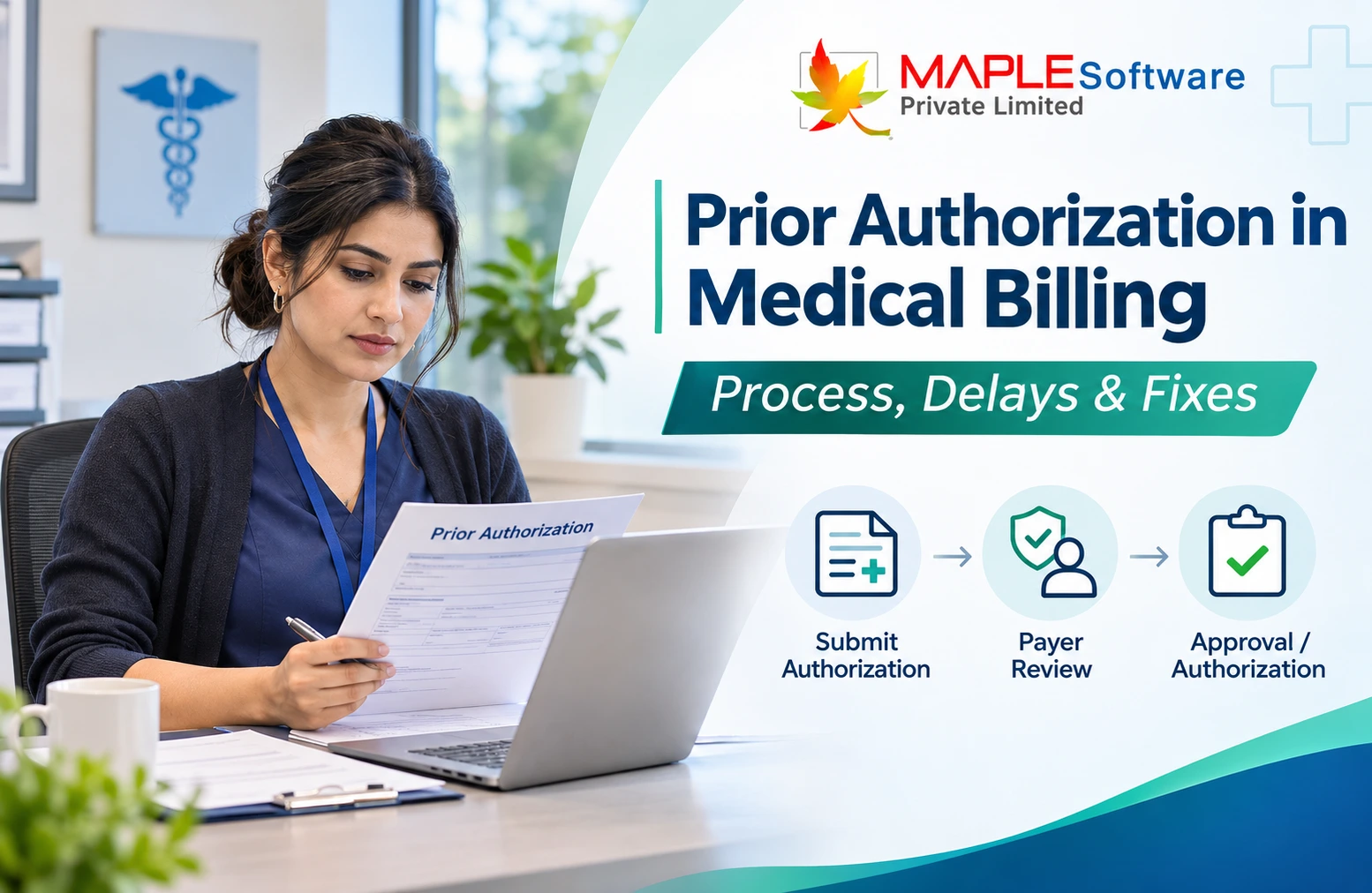
Prior Authorization in Medical Billing: Process, Delays, and How to Fix Them
A patient is scheduled for an MRI next Tuesday. On Friday afternoon, however, the reception realizes that prior approval from the insurer is required. Since there have been no requests made, the appointment may have to be cancelled. Alternatively, if the procedure is carried out and approval has not been granted, the medical facility may run into trouble with payment.
Prior authorization in medical billing involves verifying whether a particular service is covered by the licensed insurer. A difficult part for US facilities is coordinating scheduling, medical professionals, the insurer, and the billing department.
What is prior authorization in medical billing?
Prior authorization, which may also be known as preauthorization or precertification, refers to a prior review of the healthcare service, test, treatment, or procedure by the insurer. The providers that require prior authorization should submit the information needed for evaluation by the payer to determine compliance with applicable coverage rules. The comparison may result in approval, request for additional information, or denial of prior authorization.
Not every service requires authorization. Approval requirements differ across payer and plan, type of medical condition, particular procedure, provider, and place of service. A referral from a primary care physician does not equal prior authorization. Approval of prior authorization does not imply that the claim will be paid; eligibility, coding, and other billing factors do matter.
Prior authorization process in medical billing: seven practical steps
1. Verify coverage and planned service early
Begin the process once an appointment is scheduled rather than waiting until treatment day. Confirm whether there is active coverage, what the insurance plan is, verify the patient’s status of health care, and determine the exact services provided. Find out whether authorization is required based on the CPT or HCPCS code. The eligibility verification process is useful, but one cannot skip the authorization process since the first step does not substitute for authorization verification.
2. Verify the payer’s current authorization rules
Check the type of insurance plan of the patient and verify which criteria apply to it. The employer’s commercial plans may follow differing rules from Medicare Advantage plans. The insurance payer may request already conducted services and proof of medical necessity.
3. Collect relevant medical documentation
The authorization requests get stuck if the diagnosis code is not clear, if there are no records of treatment provided, or if the doctor’s recommendations are not clear. Make sure that all relevant records from the clinicians are present: referrals for treatment, notes, medical tests, treatment performed, and dates.
4. File the application through the appropriate payer’s channel
Use the channel via the insurer’s approved portal or any other electronic means the insurer recognizes. Confirm the patient’s identity, codes for procedure, service units, date, and provider and facility name. Note the submission date and confirmation number; check with the clinical team about whether something qualifies as urgent or should just be categorized as expedited.
5. Track pending submissions and reply to any requests for information
A pending application does not imply that the application is approved. Make use of a shared database that allows you to see information on the insurer, date of submission, person responsible for submitting the application, date of receipt of last communication, date on which the next follow-up is scheduled, and established appointment date. When the payer needs additional medical information, forward the request to the appropriate physician as soon as possible; if your case is urgent, ask your clinical team to take charge of the matter.
6. Record approvals and manage denials accurately
For approval, capture the authorization number, specific service, quantity of services, provider and location, and validity dates. In case of a modification in the procedure, check whether it will require a new authorization. For any type of denial, document the necessary reason and the payer’s reconsideration process, and peer-to-peer review if applicable. The final decision will always be in the hands of professionals.
7. Compare the services provided and the claim
Before billing, compare the services rendered with the approvals granted. An approval for a particular service may not cover another service, provider, or date range. Fix any discrepancies while the documents are still available.
Prior authorization vs eligibility verification vs referral
These three checks are often confused at registration. They answer different questions, so completing one does not automatically satisfy the others.
- Eligibility verification: Is coverage active, and what are the benefits? (Responsible team: Registration/eligibility).
- Prior authorization: Does this service need advance approval? (Responsible team: Authorization + clinician).
- Referral: Does the plan require a referring provider? (Responsible team: Scheduling/referring office).
A practice may need eligibility verification, a valid referral, and prior authorization for the same visit. The exact combination depends on the plan and service.
Why do prior authorization requests get delayed?
The typical issues consist of inadequately completed clinical notes, erroneous procedure codes, as well as a situation where the request is sent to an incorrect plan, information about a provider is lost or the procedure gets canceled after the authorization process.
Sometimes, the payer also needs something less than the billing team can provide. If no one is in charge of any actions or follow-ups, the request will remain unsolved till the date of the appointment itself.
As an example, it is possible to change an imaging order after approval has been granted. In case the new code does not reach the staff responsible for approvals, then the patients may encounter problems because of discontinuity in authorization practices.
What changed in the 2026 CMS prior authorization rules?
The final ruling on CMS Interoperability and Prior Authorization, CMS-0057-F, includes some decision-time limits starting in January 2026 for specific affected payers.
The designated payers have to make their decision on urgent appeals in no more than 72 hours and for standard appeals within the period of seven days in case of the services with coverage not related to medicines.
Not every plan will be obliged to comply with this restriction according to the rules. For instance, Qualified Health Plan providers working on the federally facilitated exchange will not be under the new time constraints. Thus, medical practices need to find out the exact payer and type of authorization rather than just assume.
How can medical practices prevent delays?
Use one pre-visit authorization checklist
Include eligibility, the correct payer policy, diagnosis and service codes, ordering and rendering providers, clinical notes, submission confirmation and expiration dates. Start earlier for procedures that regularly need review. Keep the checklist simple enough for a busy front-desk team to use.
Give every case an owner
Separate new submissions, requests waiting for clinical notes, payer-pending cases and denials requiring action. Assign a named employee to each item and review those tied to upcoming appointments. Escalation should follow the payer’s rules and the clinical team’s judgment, not a generic reminder schedule.
Review what causes rework
Track requests returned for missing information, appointments moved because decisions were pending, and denials linked to authorization mismatches. Compare trends by insurer and specialty. The American Medical Association’s 2025 physician survey describes continuing concerns about prior authorization burden and care delays; it does not establish the savings that any individual practice will achieve.
What should a practice do after an authorization denial?
First identify whether the decision concerns medical necessity, missing documentation, noncovered services, or an administrative error. Ask the clinician to examine the reasoning and determine whether further clinical evidence, reconsideration, peer-to-peer discussion or an appeal is appropriate. Keep payer deadlines and written responses in one record.
A denial before treatment is different from a post-service claim denial. Maple Software’s guide to common medical billing denial codes can help billing staff distinguish these situations and route follow-up work appropriately.
How Maple Software supports medical billing and authorization work
Maple Software’s medical revenue cycle management services include eligibility and benefits verification, prior authorization requests, claims processing, denial management, payment posting, and accounts receivable follow-up. If a practice is evaluating medical billing and coding services, it should ask how the vendor coordinates clinical records, payer submissions, and claim-level reconciliation rather than looking for unrealistic promises of universal approval.
The broader revenue cycle management guide explains the connected billing workflow. For practices facing repeat administrative delays, contact Maple Software to discuss an RCM review and a plan suited to the practice’s payer mix and staffing.
Frequently Asked Questions
1. What is the prior authorization process in medical billing?
A provider checks whether advance approval is required, collects supporting clinical records, submits the request, and tracks the payer’s decision. After approval, the practice should verify that the authorization matches the service provided. Prior authorization does not guarantee payment of the later claim.
2. How long does prior authorization take in 2026?
It varies by payer, plan and service. CMS-0057-F sets 72-hour expedited and seven-calendar-day standard decision limits for certain impacted payers and non-drug items and services beginning in 2026. These deadlines are not universal across all insurance plans.
3. Why are prior authorization requests denied?
Reasons include insufficient clinical documentation, failure to meet coverage criteria, service-detail mismatches or a plan exclusion. The next step depends on the insurer’s written reason. Some cases need corrected paperwork; others need review by the treating clinician and possibly an appeal.
4. Is prior authorization the same as eligibility verification?
No. Eligibility verification checks whether coverage is active and clarifies benefits. Prior authorization is an advance decision about a particular service when required. A patient may need both checks, and neither one alone ensures that a future claim will be paid.
5. Can outsourcing help with prior authorization services?
An RCM partner may coordinate policy checks, documentation, submissions, payer follow-up and recordkeeping. The practice should agree on responsibilities and escalation procedures before outsourcing. Clinical necessity decisions remain with appropriately qualified clinicians.
