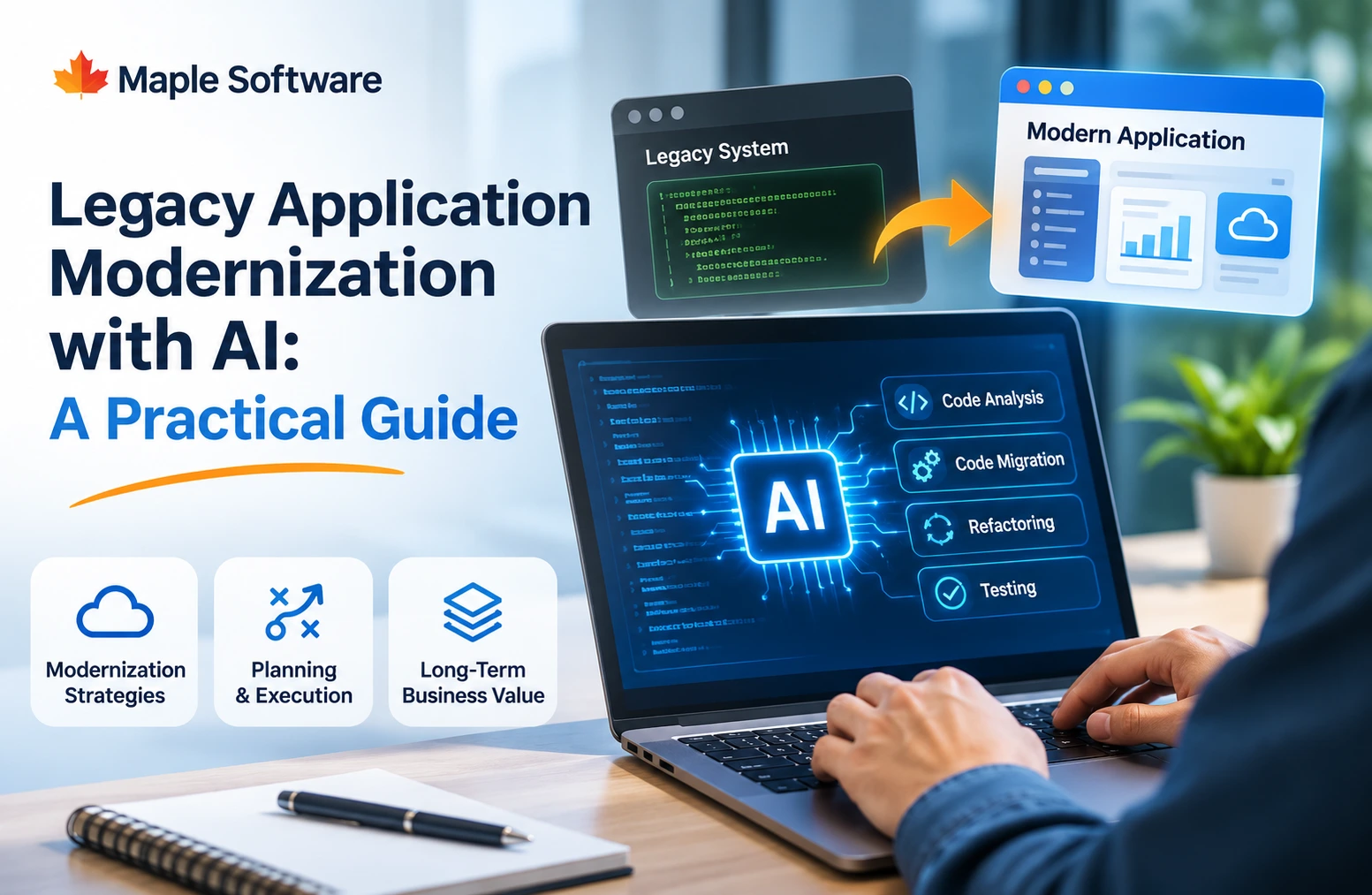
Legacy Application Modernization with AI: A Practical Guide
Solutions that have been in business for a long time can still do everything needed for their regular operation. An order gets processed, an invoice is generated, and the warehouse staff knows what buttons to push. The only thing that is required from the developer is upgrading the system or creating a client portal, after which everybody starts worrying about possible failures of the software due to the system’s changing.
Because of that, it is hard to upgrade outdated programs, as one needs to retain the rules and behaviors that are guaranteed to be in place and yet make the software more flexible. Here is where the help of AI technologies is appealing, especially if working with systems that lack documentation.
Why a working legacy system can still be expensive
Companies have their reasons to retain old applications. A billing system may be adapted for some specific types of contracts. An inventory management system may have special policies regarding returns of key customers. Maybe the new developers won’t be able to discover those rules buried in the lines of code. By replacing the application, one has to rediscover them, often after something wrong happens.
The costs appear in different forms: long deployment times, time spent by developers trying to find the root cause of small bugs, spreadsheet-based connectivity solutions, and support of versions that are no longer used. Old software is not a synonym for insecure and slow applications. But when the cost of changes becomes higher than the cost of no action, staying in place is also costly.
What AI can help engineers untangle
The first step prior to modernizing legacy systems is getting a clear understanding of their functionality, which is not an easy task due to either outdated specifications or the departure of original developers.
When joining a project, AI tools can offer developers a good starting point by providing a summary of large functions, mentioning module dependencies, and helping create missing documentation. However, developers have to check AI-generated explanations against how the system works by reviewing code, logs, and consulting end-users.
We can use AI for helping with syntax conversions and framework migrations. We can also rely on AI-assisted programming for simplifying redundant logic blocks. Despite the fact that the code compiled successfully, it can still mislead us. For example, we can design an inventory procedure that calculates the normal orders in a correct way, while treating some of the returns improperly. This outcome can be identified only in the course of testing.
AI can also help with suggesting tests, yet it will not be able to provide us with the expected results where business logic is missing.
Six modernization options, from modest fixes to replacement
Unsupported servers don’t necessarily call for a rewrite. And moving to the cloud won’t fix tangled business logic. The right application modernization strategy depends on what actually needs to change.
| Approach | What changes | When it makes sense
|
|---|---|---|
| Rehosting | Where software runs | Infrastructure is the main problem |
| Replatforming | Runtime or platform | A supported environment is needed |
| Refactoring | Internal code | Working logic is hard to maintain |
| Rearchitecting | System structure | Integration or scale is constrained |
| Rebuilding | Custom application | The original design no longer fits |
| Replacing | Business product | An available product meets the needs |
These six decisions are different from AWS’s seven cloud migration strategies. Projects often combine approaches: replatform one service, refactor another, and leave a stable reporting function alone. A gradual plan may be far less disruptive than changing everything at once.
Plan the work around what must keep running
An inventory manager doesn’t care which programming language a new system uses if stock numbers are wrong on Monday. Start with the transactions that cannot fail: payments, order allocations, customer credits. Record how they work, including the odd cases employees handle manually.
Then map dependencies. Look beyond the main database to scheduled jobs, outside services, exports, permissions, and workstation software. Speak to staff who depend on the system. Their practical knowledge often reveals behavior missing from technical diagrams.
Before approving major development, ask for four things:
- A measurable reason for the change, such as a reliable integration or safer updates.
- Tests based on actual workflows, including exceptions and data reconciliation.
- A phased release with clear sign-off and acceptable downtime.
- A backup and rollback plan that has been tested.
A proof of concept can expose bad assumptions before they become expensive. Microsoft’s application modernization lifecycle similarly connects assessment, delivery, and ongoing improvement. The need for maintenance doesn’t end at launch.
A practical example: modernize the bottleneck
Think of a fictitious wholesaler whose inventory application has been operational for 15 years. The warehouse relies upon its stock calculations, but its online orders have to be tediously entered twice due to the absence of a proper API. The management of the company considers a complete system replacement.
In fact, the team of engineers documents stock level adjustment procedures and establishes the connections between databases. The AI helps clarify the processes and create testing procedures. Staff members are assigned to validate returns and partial shipments while API is incorporated around the necessary functions maintaining the original system.
Costs and risks a code conversion won’t remove
The cost of modernization does not only take into consideration the amount of code. Costs may be influenced by even such factors as the lack of documentation, integration difficulties, the cleaning of data, the need for testing environments, uptime and staff training. Special care should be taken while migrating legacy systems involving financial and regulated information. No reliable universal price can be given without specific technical analysis.
AI also carries its own risks. The produced code may work using vulnerable dependencies, may fail to deal with access control or may disclose non-authorized sensitive information. NIST Secure Software Development Framework outlines safeguards while developing software, while OWASP Instruction on Security in AI programming provides considerations specifically for AI development. Both of them highlight the importance of review and testing by a person.
Finding a partner who asks the right questions
A professional custom software development firm ought to inquire about application users, the application’s failures, and a description of a successful solution. Be cautious of recommendations that each application ought to be rewritten before a discussion of the data and the business.
Seek clarification too on architecture decisions, data migration validation, the results of any failure during deployment, and, importantly, who will support the system after its launch. A guide on how to choose a software development partner from Maple Software provides additional questions for such activities.
The custom software development services the company is engaged in include legacy modernization, platform migration, application development, and integration. Taken together, these items justify the applicability of Maple Software in the initial assessment of outdated software.
Begin with the problem worth fixing
A useful modernization project may simply remove a risky dependency or make one vital integration reliable. AI can help engineers investigate and implement such changes, but the results still need to match actual business behavior. If you’re weighing an upgrade, you can talk to Maple Software about what to test first.
Frequently Asked Questions
What is meant by legacy application modernization?
Legacy application modernization can be said to involve component upgrade, code upgrade, architecture modification, infrastructure migration or complete software replacement. Which way to choose depends on the problem being handled. It still remains crucial to maintain core business processes.
Is it possible to use AI for migrating legacy application without involving programmers?
AI can be used, but it cannot do it completely without human help. AI can assist in carrying out the translation of the code, determining test plan and documenting the functions. It is still required for both developers and business users to check how components integrate with their software.
Is migrating to cloud the same as modernizing applications?
No. Cloud-based solutions can improve the flexibility of infrastructure, but do not concern the modernization of the architecture itself.
What is the price of modernizing old software?
The cost of modernization is determined by the nature of the code, amount of data to be migrated, complexity of integrations, testing needs and downtime thresholds. A targeted upgrade and complete redesign are two completely different ventures. At the discovery stage all options must be evaluated before reaching the decision on the budget.
What should be inquired when contacting a modernization firm?
The question should be on how they will find out dependencies, confirm present behavior, protect the code, test passed data and conduct the rollback processes. It is important to have a detail explanation of all the assumptions made in the plan rather than just the list of tools.